Aeronautical Decision Making — The Most Important Skill in Aviation
Technical flying skill will keep you safe in routine situations. ADM — Aeronautical Decision Making — will keep you safe when the situation isn't routine. Investigations consistently show that most GA accidents are not caused by mechanical failure or inadequate skill. They are caused by decisions: to fly into weather, to skip the fuel stop, to push through fatigue, to succumb to external pressure. This module addresses those decisions directly.
- Explain the five hazardous attitudes and their antidotes
- Apply the DECIDE model to an in-flight scenario
- Describe IMSAFE and explain how each element affects pilot performance
- Explain situational awareness and describe how it degrades under stress
- Describe the risk management frameworks used in GA: PAVE, 5Ps, and personal minimums
- Explain the accident chain concept and identify intervention points
- Describe how automation complacency and task saturation affect modern GA pilots
Lesson 1 — The Five Hazardous Attitudes
The FAA identified five specific attitude patterns that are reliably associated with aviation accidents. These are not character flaws — they are normal human tendencies that become dangerous in the cockpit. Every pilot has experienced all five at some point. The goal is not to eliminate them (impossible) but to recognize them and apply the specific antidote before they influence a flight decision.
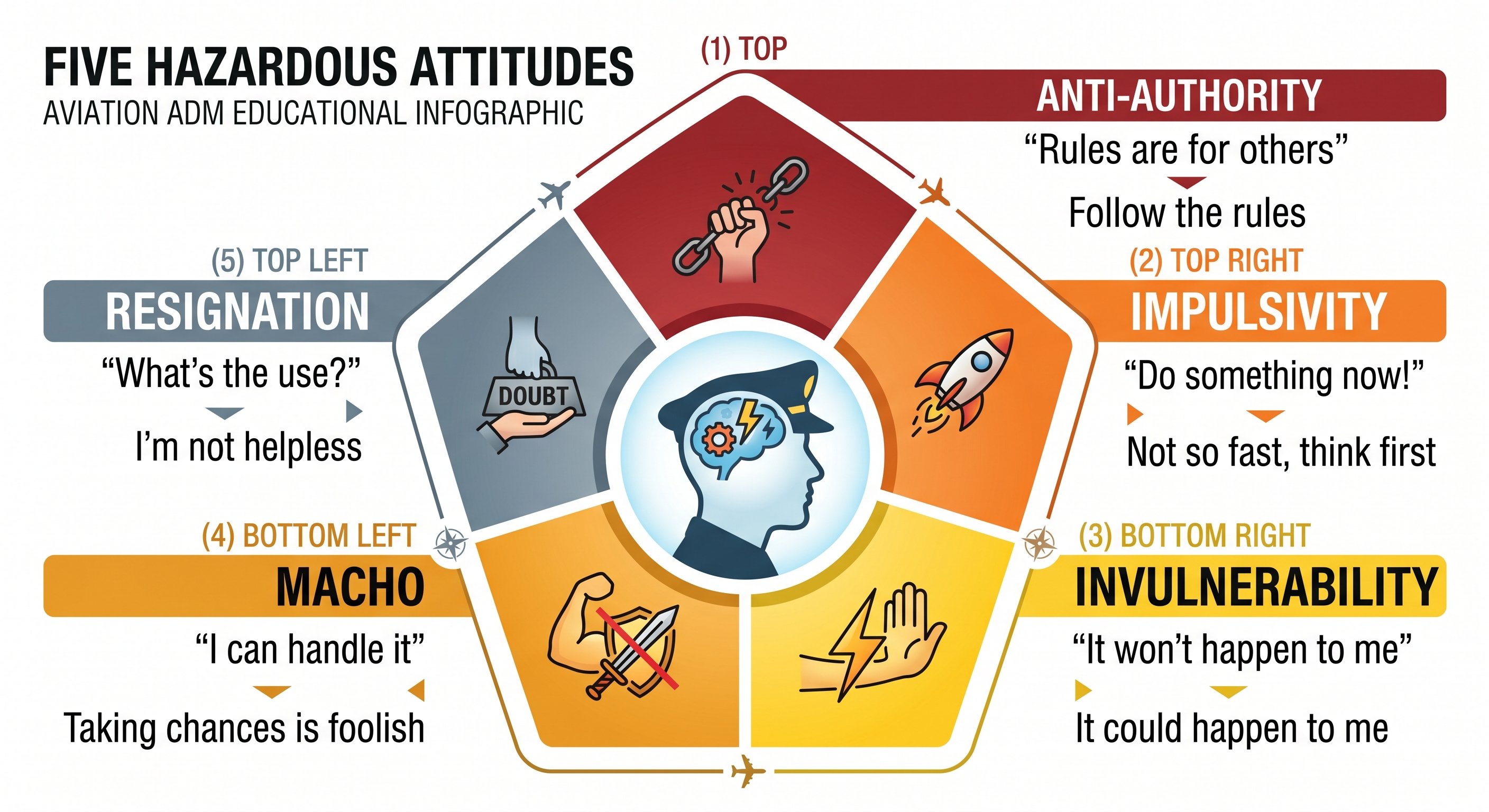
| Attitude | Thought Pattern | Antidote |
|---|---|---|
| Anti-authority | "Rules are for other people. I know better than the FAA." Resentment of external rules, procedures, or suggestions from controllers or CFIs. | "Follow the rules — they are usually right." Rules derive from accidents. Most FARs were written in blood. Disagreeing with a rule is appropriate; ignoring it in flight is not. |
| Impulsivity | "Something is wrong — do something immediately!" Acting without thinking — the first action that comes to mind, before assessing the situation. | "Not so fast — think first." In most non-catastrophic emergencies, 5–10 seconds of thought produces far better outcomes than instant action. Maintain aircraft control first, then think. |
| Invulnerability | "Accidents happen to other pilots. I have enough experience to handle this." Believing that one's own experience or skill exempts them from the risks that affect other pilots. | "It could happen to me." Experience increases skill but does not eliminate the hazards. Some of aviation's most experienced pilots have made fatal decisions while believing themselves beyond risk. |
| Macho | "I can handle it. I'll prove I can do this." Taking risks to impress others, or refusing to admit limitations to maintain a tough image. | "Taking chances is foolish." True skill is knowing your limits and operating within them. Deciding not to fly in deteriorating weather is an act of expertise, not weakness. |
| Resignation | "What's the point? Luck decides everything anyway. There's nothing I can do." Passive acceptance of bad outcomes without action, often disguised as fatalism. | "I'm not helpless — I can make a difference." Pilots have enormous influence over their outcomes. The aircraft, the weather, the systems all respond to pilot action. Act. |
Recognizing attitudes in real time: Hazardous attitudes are rarely obvious to the person experiencing them. They disguise themselves as reasonable thoughts. "The forecast looks bad but I know this route" sounds like experience — it may be invulnerability. "My passenger is counting on me to get there" sounds like responsibility — it may be impulsivity or macho masquerading as obligation. Periodically ask yourself: which of these five attitudes might be influencing my thinking right now?
Each hazardous attitude in a real flight scenario
Anti-authority in practice: "The chart says I need 3 SM visibility but I can see the airport — that rule is for people who can't fly." This attitude dismisses regulatory guidance as bureaucratic overhead. The antidote — "Follow the rules; they're usually right" — exists because the rules were often written in response to accidents. The VFR minimums aren't arbitrary; they reflect human reaction time at closing speeds. The pilot who routinely violates minimums "just a little" is building a habit that eventually produces a fatal outcome.
Impulsivity in practice: The weather is marginal. The pilot checks the METAR, sees "BKN020" (broken at 2,000 ft), and immediately decides to go because "I'll be fine at pattern altitude." No second check. No TAF review. No call to Flight Service. The decision is made in 10 seconds based on incomplete information. The antidote: "Not so fast — think first." Build in a deliberate pause before any go/no-go decision.
Invulnerability in practice: "That kind of accident happens to low-time pilots or people who take chances. I've been flying for years without a problem." Experienced pilots are not immune to accidents — some accident categories actually increase with experience because familiarity breeds complacency. The antidote: "It could happen to me." Treat every flight as if something could go wrong, because it can.
Macho in practice: ATC offers an altitude that would require penetrating marginal IMC. The pilot accepts rather than admitting the conditions are beyond their capability. Peers pressure a pilot to make a flight the pilot has reservations about. The antidote: "Taking chances is foolish." Real skill includes knowing when to say no.
Resignation in practice: The engine starts running rough during cruise. Instead of troubleshooting and making a divert decision, the pilot thinks "it's probably nothing — I'll see how it goes." When things go wrong, resignation prevents action. The antidote: "I'm not helpless — I can make a difference." Every situation has actions that improve the outcome.
Lesson 2 — The DECIDE Model
The DECIDE model is a structured six-step decision-making process designed to slow down in-flight decisions and ensure each step is completed deliberately rather than impulsively. It is most useful for non-time-critical decisions — a rapidly deteriorating emergency requires immediate action, not a six-step model. But for the many situations that present as problematic but not yet catastrophic — changing weather, unfamiliar airport, navigation uncertainty — DECIDE provides structure.
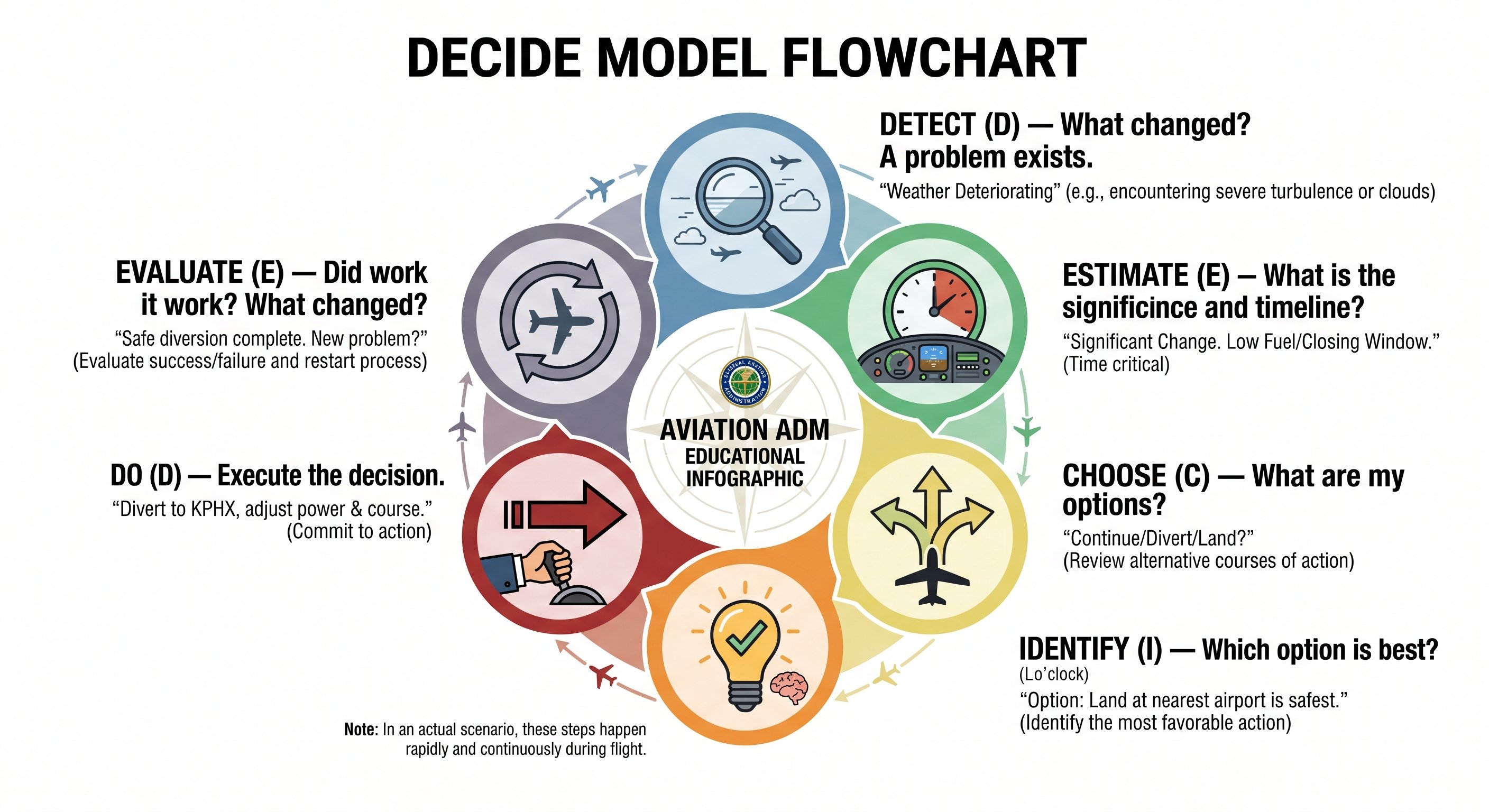
| Step | Question | Example |
|---|---|---|
| D — Detect | What has changed? What is the problem? | The ceiling ahead is lower than forecast. I can see clouds building that weren't there an hour ago. |
| E — Estimate | What is the significance? How much time do I have? | At my current groundspeed, I'll reach those clouds in about 25 minutes. My destination weather was marginal on the last check. |
| C — Choose | What are my options? | Continue on course hoping it improves. Divert to the airport 30 miles east that has clear skies. Land at the nearest airport now and wait. |
| I — Identify | Which option is best? | Divert east — clear skies there, rental car available, no time pressure that justifies continuing into marginal VFR. |
| D — Do | Execute the choice. | Turn eastbound now. Get the new ATIS. Brief the passenger. Update the fuel calculation. |
| E — Evaluate | Did the action work? Has the situation changed? | Skies clearing as I head east. Destination weather confirmed VFR. Fuel sufficient. Good call — continue. |
DECIDE applied to a real in-flight scenario
Scenario: 45 minutes into a cross-country, you notice the weather ahead looks darker than expected. The TAF showed VFR, but there's a line of buildups in the direction you're flying. Here's DECIDE in action:
Detect: Something has changed. The visual weather ahead is inconsistent with what was forecast. This is the trigger — you've detected a change from the expected situation.
Estimate: How significant is this? The buildups appear to be towering cumulus, not cumulonimbus — no anvil tops yet. But they're directly on your route. Continuing could mean entering marginal VFR or worse within 20 minutes.
Choose: Three options: (1) Continue and see what develops — the macho/invulnerability trap. (2) Deviate laterally to go around the buildups if they're not a solid line. (3) Turn back or divert to a nearby airport now, while you have margin.
Identify: Option 3 is the conservative choice. The nearest airport is 12 miles left. Weather there (from last ATIS) was VFR. The deviation adds 25 minutes to the flight but keeps you clear of the buildups.
Do: Turn left, contact Flight Service for an updated area forecast and PIREP information, request radar advisories from Center.
Evaluate: After the turn, the buildups are to the right and the sky to the left is clear. The decision was correct. Continue evaluating as the flight proceeds — if the buildups begin moving toward your new track, DECIDE again.
When DECIDE is too slow — the FORDEC alternative for time-critical decisions
DECIDE is ideal for non-time-critical decisions where you have minutes to deliberate. For faster decisions, some operators use FORDEC: Facts (what do I know?), Options (what can I do?), Risks and benefits (of each option), Decision (choose), Execute, Check (monitor the outcome). The difference: FORDEC compresses the evaluation by running through options and risks simultaneously rather than sequentially.
For a new private pilot, the specific model matters less than developing the habit of deliberate decision-making — rather than impulse decisions ("I'll just go") or paralyzed non-decisions ("I don't know what to do"). DECIDE provides structure when you're new to in-flight decision-making. Over time, experienced pilots internalize the process and execute it naturally without consciously naming the steps.
Recognizing when a decision is needed — the trigger
The hardest part of the DECIDE model isn't working through the steps — it's recognizing that a decision is needed at all. Pilots who end up in trouble often say afterward "I didn't realize how bad it was getting." The trigger — the "Detect" step — is the awareness that something has changed from expected. Build the habit of regular mental status checks: every 15 minutes during cruise, ask "is everything still going as expected?" If the answer is "mostly yes but..." — start DECIDE. Don't wait for the situation to become obviously bad.
Lesson 3 — IMSAFE: The Personal Preflight Checklist
IMSAFE is the personal preflight checklist — a self-assessment performed before every flight to identify personal factors that could affect safety. Aircraft preflights are standard; personal preflights are equally important and often skipped.
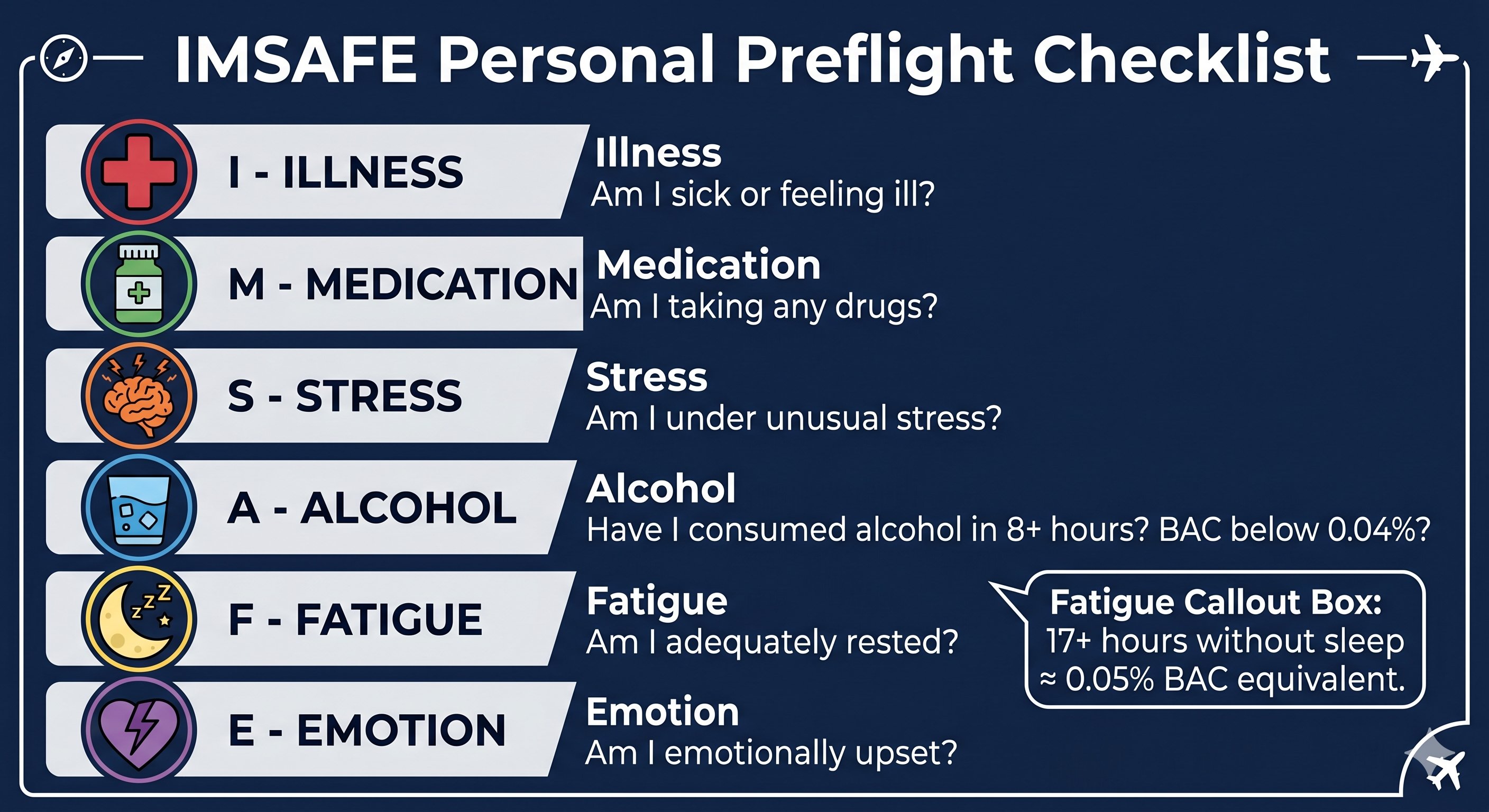
| Letter | Factor | Ask yourself |
|---|---|---|
| I | Illness | Am I sick, even mildly? Any symptoms — congestion, headache, nausea, dizziness — are amplified at altitude and can indicate conditions (ear and sinus blocks) that worsen with altitude changes. |
| M | Medication | Am I taking any medication? Even OTC drugs like antihistamines, decongestants, and sleep aids impair pilot performance measurably. Many are on the FAA's prohibited list. |
| S | Stress | Am I under unusual personal, financial, or work stress? Stress consumes working memory and narrows attention — the same mental resources needed for safe flight. |
| A | Alcohol | Have I consumed alcohol within the past 8 hours (legal minimum) or 12–24 hours (operational standard)? Am I otherwise "under the influence" even if the 8-hour window has passed? |
| F | Fatigue | Am I rested? Fatigue is among the most dangerous and under-recognized performance degraders in aviation. More than 17 hours without sleep produces impairment equivalent to 0.05% BAC. |
| E | Emotion | Am I in an emotional state — grief, anger, excitement — that could compromise objectivity and decision-making? Emotional arousal narrows thinking and biases decisions. |
Fatigue — the invisible impairment: Fatigued pilots almost universally underestimate their impairment — the same way drunk drivers believe they drive fine. Research shows that 24 hours without sleep produces impairment equivalent to a BAC of approximately 0.10% — well above the legal driving limit. There is no shortcut, stimulant, or technique that eliminates the effects of sleep deprivation. If you are fatigued, don't fly. This is not optional.
Honest application of IMSAFE — the questions pilots skip
IMSAFE is only valuable if applied honestly. Each letter requires asking the hard version of the question:
Illness: Not just "do I feel sick?" but "am I 100% of my normal?" A mild headache, the beginning of a cold, a stomach upset — these are all "yes" answers to Illness that should give pause. Mild illness impairs attention and judgment. Flying while "almost sick" may be legal but it's not safe.
Medication: Not just "am I taking prescription medication?" but "am I taking anything — including OTC medications — that could affect alertness, vision, or coordination?" Antihistamines (Benadryl), decongestants (Sudafed), sleeping pills from the night before, anti-nausea medication — all can affect pilot performance. The FAA's medication guidance is extensive; when in doubt, don't fly.
Stress: Not just "am I under stress?" but "is my mind clear enough to fly?" Financial worry, relationship problems, a difficult work situation, a family emergency — significant stress occupies working memory that should be dedicated to flying. A pilot whose mind is on the ground problem cannot be fully present for the in-flight problem.
Alcohol: Not just "have I had a drink in the last 8 hours?" but "am I completely hangover-free?" A pilot who drank four beers the night before and slept six hours may pass the 8-hour and 0.04% BAC tests but still have degraded performance from dehydration, interrupted sleep, and residual alcohol metabolites.
Fatigue: Not just "did I sleep last night?" but "am I rested enough to handle an unexpected situation 90 minutes into this flight?" Fatigue is cumulative. Three consecutive nights of poor sleep is not corrected by one adequate night. Ask yourself: if something unexpected happens on this flight — an engine roughness, a sudden weather change, an ATC error — am I sharp enough to handle it correctly?
Emotion: Not just "am I upset?" but "would an observer describe me as emotionally stable right now?" Anger, grief, anxiety, and excitement all impair judgment in different ways. Excitement is as dangerous as anger — the enthusiastic pilot who flies into a cloud "just to see what it's like" is as impaired by emotion as the angry one.
Lesson 4 — Situational Awareness
Situational awareness (SA) is knowing what is happening around you — where you are, what the aircraft is doing, where you are going, what the weather is, who else is in the airspace, and what might happen next. SA is not a checklist item — it is a continuous, active process of maintaining an accurate mental picture of the entire operational environment.
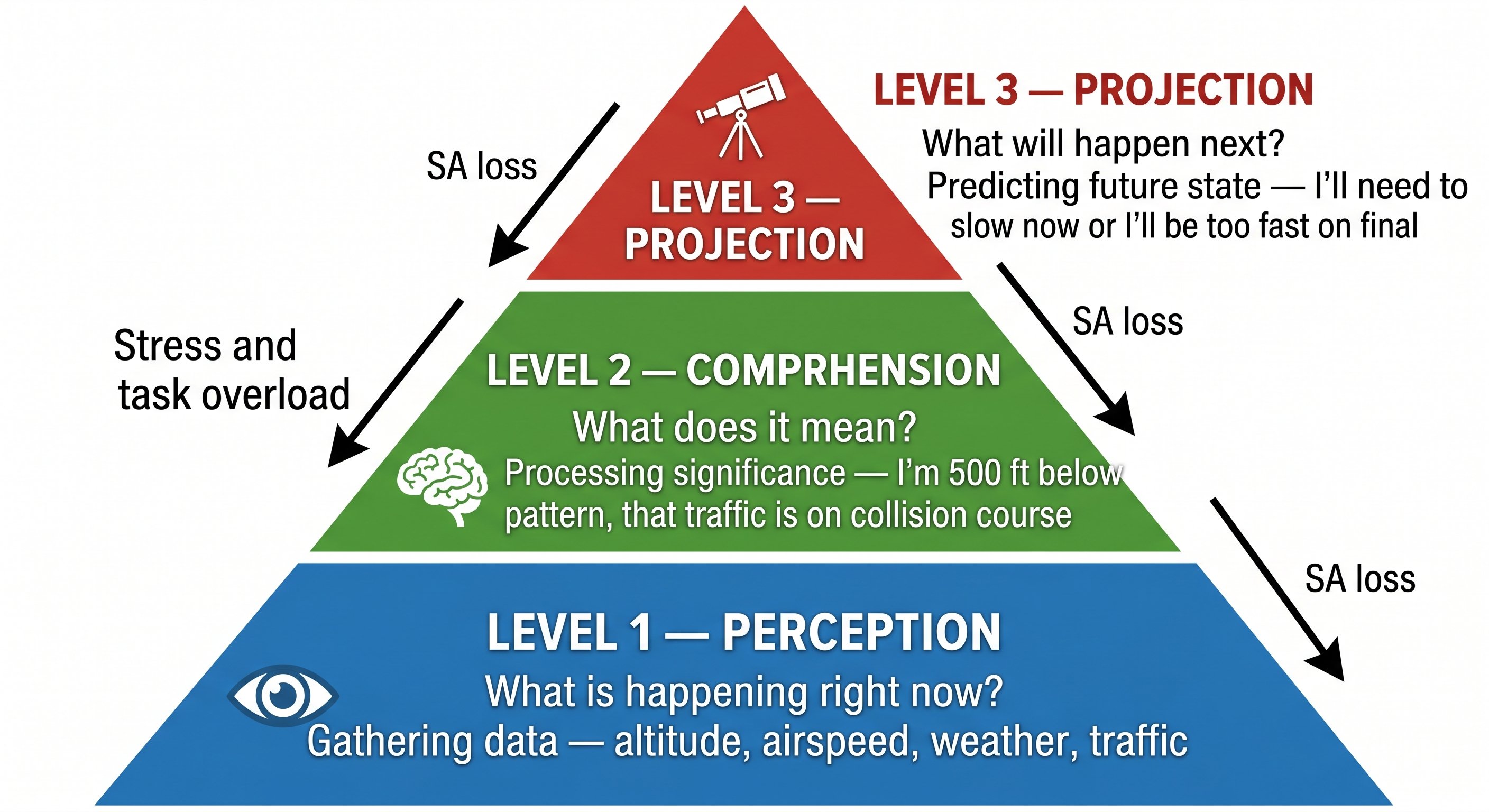
The three levels of situational awareness
Level 1 — Perception: Gathering raw data. Airspeed 90 kts. Altitude 4,500 ft. The tower just said hold short of runway 27. These are facts you observe.
Level 2 — Comprehension: Understanding what those facts mean. Airspeed 90 kts is 10 kts above VREF — I need to slow down. I'm at 4,500 ft with a 3,500 ft MSL airport ahead — I'm only 1,000 ft above traffic pattern altitude. These are implications.
Level 3 — Projection: Anticipating the future state. At my current speed and descent rate, I'll be at pattern altitude in about 3 minutes. That gives me limited time to set up for the approach. I should start slowing now. This is prediction.
Most SA failures occur at Level 1 (missed a piece of data) or between Levels 1 and 2 (gathered the data but didn't process its significance). Cockpit fixation — becoming intensely focused on one task while losing awareness of everything else — is a Level 1 SA failure caused by task overload.
How situational awareness degrades
Task saturation: When workload exceeds capacity, lower-priority tasks are dropped. Often those "lower priority" tasks are the ones that would have caught the problem — like checking fuel, confirming airspace, or listening to the weather update. High-workload phases (approach in bad weather, unfamiliar airport, mechanical issue) are when SA is most critical and most at risk.
Channelized attention (tunneling): Becoming intensely focused on one task — like a radio frequency or a navigation problem — while losing track of aircraft attitude, altitude, or traffic. A classic GA accident pattern: pilot distracted by a malfunction or communication issue, fails to notice altitude decreasing, controlled flight into terrain.
Expectation bias: Perceiving the world as you expect it to be rather than as it is. If you expect the runway to be clear, you may not notice the aircraft that landed ahead of you. If you expect the VOR to work, you may not notice you've been navigating on an unreliable signal.
Situational awareness — what losing it actually looks like
SA loss rarely happens all at once. It degrades gradually, often unnoticed, through a predictable sequence:
Level 3 SA (full awareness): You know where you are, you know what's ahead, you know the weather, you know the traffic, and you have a plan for the next 10 minutes. This is the normal state in cruise on a clear day with a good weather briefing.
Level 2 SA (degraded): You know roughly where you are, but you've been heads-down for a few minutes and haven't verified your position recently. The weather looks slightly different than forecast but you haven't confirmed it's not a problem. You're not sure if there's Class C ahead or if you've already passed it.
Level 1 SA (poor): You're not sure of your exact position. You're behind the aircraft — the approach to the airport surprised you because you didn't realize how close you were. You're task-saturated with a radio problem and haven't scanned for traffic in several minutes.
SA collapse: You don't know where you are. The situation has gone beyond what you can process. The instrument scan has stopped. The aircraft is no longer under positive control.
The early warning signs of SA degradation: head-down time increases, radio calls feel harder to compose, you're surprised by ATC instructions you should have anticipated, you're behind the aircraft rather than ahead of it. These are cues to stop and rebuild SA — climb, level off, slow down, call Flight Service, ask ATC for help. Asking for help at Level 2 is smart. Waiting until Level 1 is dangerous.
Lesson 5 — Risk Management Frameworks
Risk management in aviation is the systematic identification and mitigation of risks before they become accidents. Three frameworks are widely used in GA and are tested on the written exam.
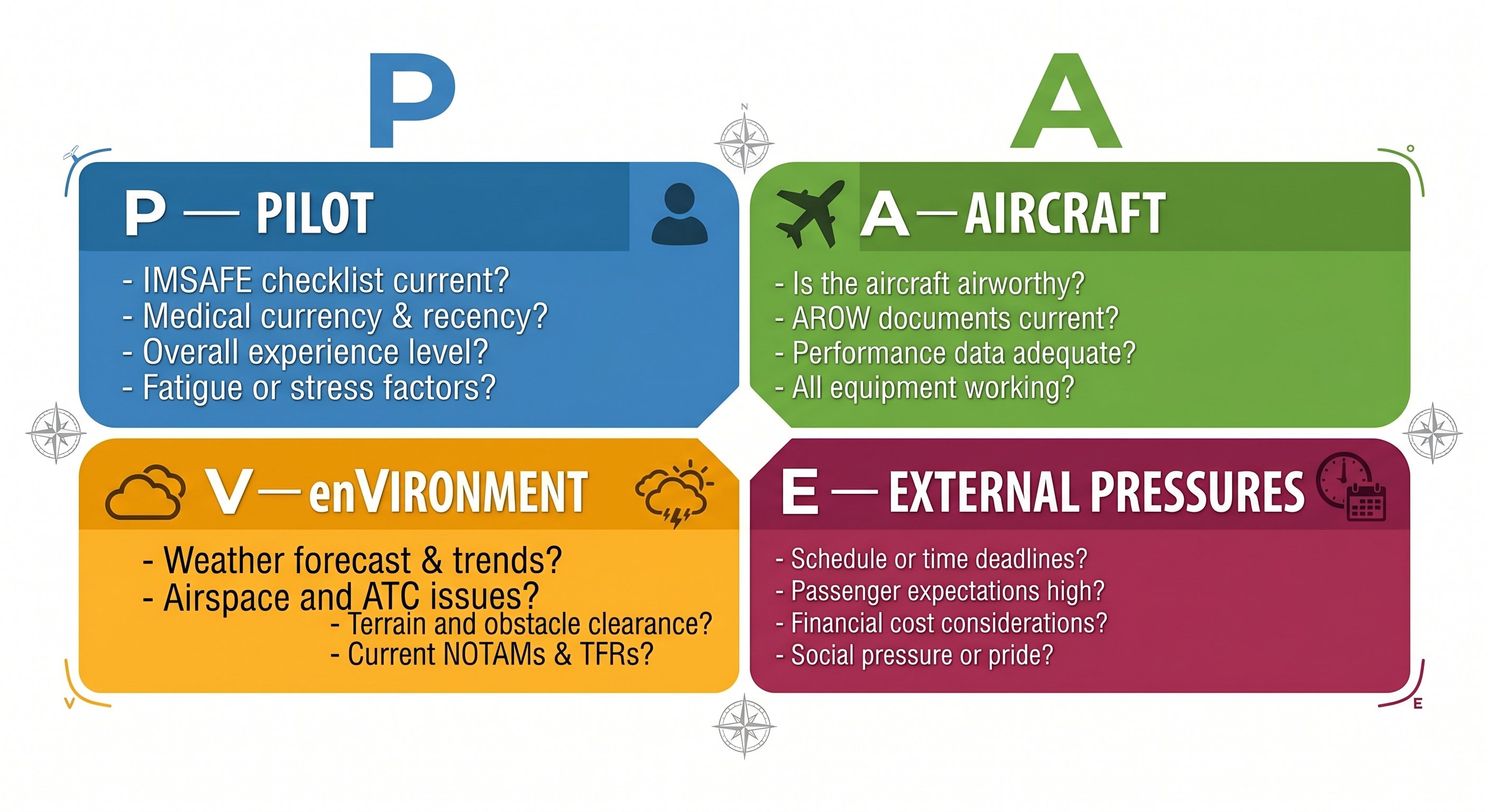
PAVE — identifying risk before flight
PAVE is a four-category risk framework used during preflight planning to identify risks that could affect the flight:
- P — Pilot: IMSAFE. Currency (within 90 days, flight review current). Experience (hours in type, familiarity with route, night or IMC proficiency). What's the weakest link in your personal chain today?
- A — Aircraft: Airworthy (all AROW documents, inspections current)? Performance adequate (weight and balance, obstacle clearance, landing distance on available runway)? Equipment working (everything you need for the flight)?
- V — enVironment: Weather (METARs, TAFs, AIRMETs, PIREPs). Airspace (TFRs, NOTAMs, special use). Terrain (MEF values, mountain wave potential). Time of day.
- E — External pressures: What is driving this flight? Commitment to passengers? Schedule pressure? Social obligation? Any of these can distort go/no-go judgment.
The 5 Ps — continuous in-flight risk assessment
While PAVE is a pre-departure tool, the 5 Ps provide a framework for continuous in-flight risk reassessment:
- Plan — is the original plan still valid? Has anything changed that requires a re-plan?
- Plane — is the aircraft performing as expected? Any anomalies in instruments, sounds, or feel?
- Pilot — IMSAFE. How am I doing? Is workload increasing? Am I tired or stressed?
- Passengers — are passengers well? Any motion sickness, anxiety, or distraction from them?
- Programming — is the avionics/GPS programmed correctly? Do the waypoints make sense? Is my automation doing what I think it's doing?
Personal minimums — your private regulations
Personal minimums are self-imposed operational limits that are more conservative than FAA minimums. They account for your individual experience level, currency, and comfort. A newly certificated private pilot's personal minimums should be significantly higher than the legal VFR minimums. The critical rule: establish personal minimums in advance, in writing, when you are NOT looking at specific weather. If minimums are set while reviewing actual forecast data, confirmation bias will tend to make the minimums conveniently match the current conditions.
Example personal minimums — new private pilot:
Ceiling: 3,000 ft (vs legal 1,000 ft for VFR)
Visibility: 5 SM (vs legal 3 SM for class G)
Crosswind: 10 kts (vs demonstrated crosswind component of 15 kts)
Night flight: Only airports I have flown to in daylight first
Solo cross-country: Maximum 2 hours from familiar area
As currency and experience grow, personal minimums evolve. The goal is minimums that produce safe, margin-appropriate decisions — not minimums that regularly prevent any flight.
PAVE — working through it for a real flight decision
Scenario: you're planning a Saturday afternoon cross-country with your spouse to visit family, 180 nm away. You planned to leave at 2 PM. It's 1 PM. Work through PAVE:
Pilot: You've flown 4 times in the past 3 months — not as current as ideal, but legally current. You're not tired, not stressed, no medications. You haven't flown in 3 weeks. Honest assessment: proficiency is slightly below your best. Manageable, but worth acknowledging.
Aircraft: The rental C172 was last flown yesterday — no recent issues. Annual is current. You do the weight and balance: you and your spouse, bags, full fuel. Max gross weight: 2,550 lbs. Actual: 2,535 lbs. Legal — but 15 lbs from gross. CG is within the envelope, but toward the aft limit. Noted.
enVironment: Weather at departure: clear, 15 knots from the southwest. Weather at destination: ceiling 3,500 broken, 8 SM, winds 20G28. AIRMET Sierra covers the destination area with IFR conditions possible along the route after 6 PM. En-route weather: one reporting station mid-route shows 4,500 scattered. Forecast: generally VFR but deteriorating after 4 PM. Your ETA: 3:45 PM.
External pressures: Family is expecting you. Dinner is planned. You haven't seen them in three months. Your spouse is excited.
Decision: Depart now (1 PM) instead of 2 PM to arrive before the deterioration window. Or: call the family and plan to drive if weather doesn't improve. The external pressure to arrive on schedule is present and recognized — it's a risk factor. The decision to depart early is a mitigation that reduces the weather risk but requires action now.
3P model — an alternative risk framework
The 3P model (Perceive, Process, Perform) provides a simpler framework for time-critical situations where PAVE and DECIDE feel too elaborate:
Perceive: Gather information about the hazards present right now. What do you see, hear, and know about the current situation?
Process: Evaluate the hazards. What are the risks? How severe? How probable? What's the worst case?
Perform: Apply the best risk management strategy. Then monitor the outcome and loop back to Perceive.
The 3P model is faster than DECIDE and works well for ongoing in-flight decisions where you're cycling through the assessment continuously — not just at a single decision point.
Lesson 6 — The Accident Chain
Most GA accidents do not result from a single catastrophic failure. They result from a chain of events, each of which — had it been identified and interrupted — could have prevented the accident. Post-accident investigations routinely reveal that 4–6 separate links in the chain were visible and addressable before the fatal outcome.
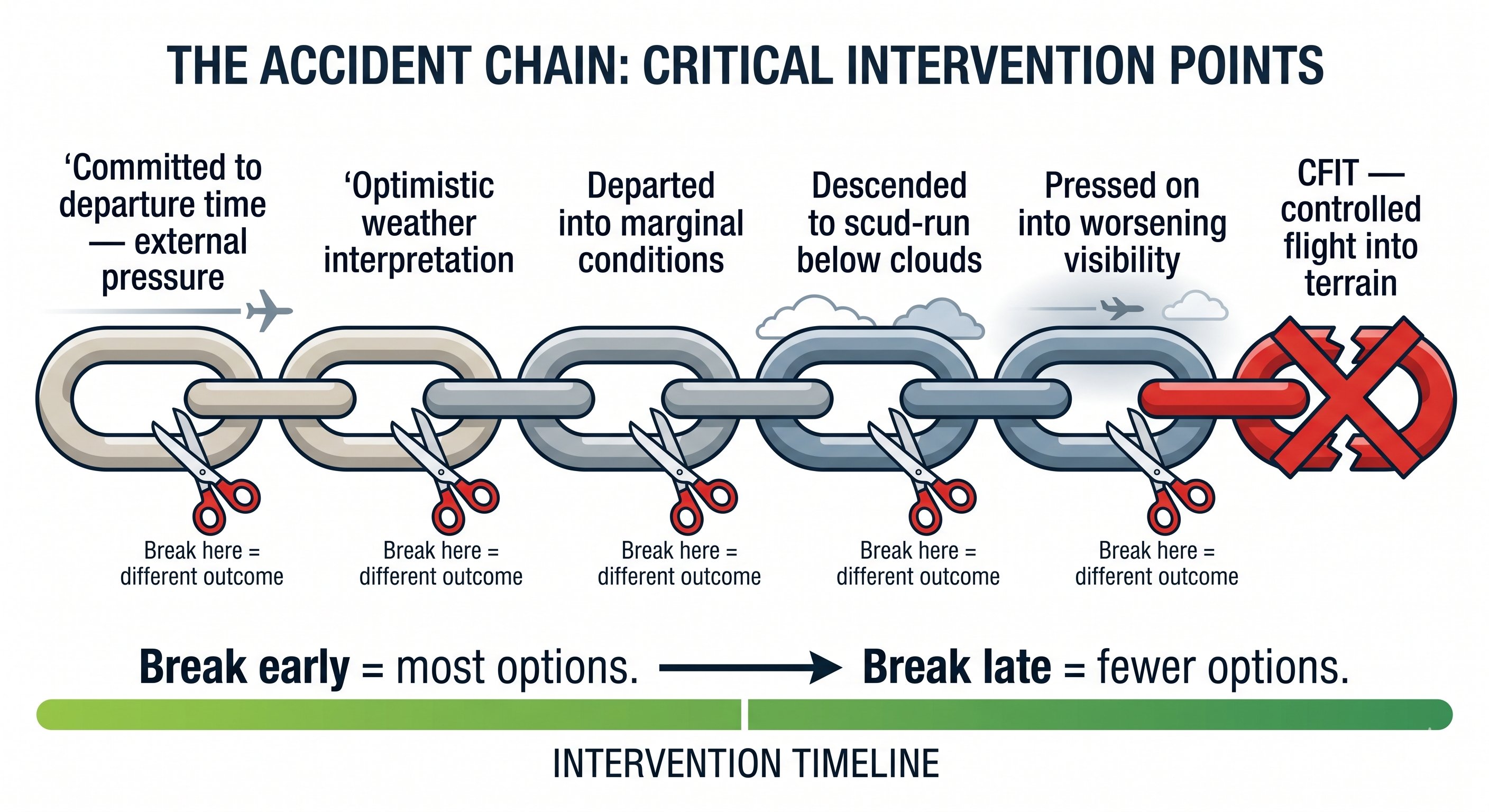
The typical chain structure
A representative accident chain might look like this:
Link 1: Pilot commits to an important flight departure time due to social pressure (a destination event with people waiting).
Link 2: Forecast is marginal but not definitive. Pilot gets a standard briefing and interprets the borderline conditions optimistically.
Link 3: Departure is delayed 30 minutes — conditions are deteriorating but still technically VFR. Pilot decides the delay means conditions are "passing through."
Link 4: En route, conditions are lower than forecast. Pilot descends to remain VFR below clouds.
Link 5: Visibility decreases further. Pilot is now scud-running — VFR flight below a low ceiling attempting to maintain visual contact with terrain.
Link 6: Terrain rises. Pilot continues, hoping it will improve ahead, unwilling to turn around into conditions already passed through.
Outcome: Controlled flight into terrain (CFIT).
Any one of those links, if broken, changes the outcome. Breaking the chain early — at Link 1 or Link 2 — produces the easiest solution with the most options. Breaking it at Link 5 requires an aggressive divert, a turnback into IMC, or an off-airport landing. The chain doesn't care how late you break it — it can always be broken — but earlier is far easier and safer.
The scud-running trap: Scud-running — flying VFR below a low ceiling to maintain visual contact with terrain — is one of aviation's most reliably fatal patterns. Each mile forward seems reasonable because conditions look similar ahead. But conditions are unknown ahead, the ceiling can descend to the terrain, and turning around in worsening conditions may now put you back into what you just flew through. VFR flight should never begin in conditions where the ceiling is below the surrounding terrain's MEF.
Anatomy of a real accident chain — NTSB analysis pattern
Let's trace a realistic accident chain — not a real incident, but representative of patterns seen repeatedly in NTSB data:
Link 1 — Scheduling pressure: Pilot commits to a Saturday morning flight to a business meeting, leaving no weather margin. The flight must happen at 8 AM.
Link 2 — Marginal weather ignored: Weather briefing shows marginal VFR at the destination — 1,800 ft broken, 5 SM. TAF shows possible improvement by 10 AM. Pilot decides to go anyway.
Link 3 — Deterioration not anticipated: En-route, weather at the destination drops to 1,200 ft broken, 3 SM. The SIGMET the pilot didn't notice was issued at 7 AM for the destination area.
Link 4 — Continued into deteriorating conditions: Pilot is 40 miles out. Turning back means missing the meeting. Continues rather than diverting to a VFR airport 20 miles left.
Link 5 — VFR into IMC: 15 miles from the destination, the pilot enters the cloud layer. Not instrument rated. No SVFR clearance. Spatial disorientation begins within 60 seconds.
Link 6 — Loss of control: The aircraft enters a graveyard spiral. The pilot, unable to trust the instruments they barely understand, pulls back as airspeed increases. The aircraft exceeds Vne. Structural failure.
Any one of these links, broken at any point, prevents the outcome: a different departure time, a weather call to Flight Service, a divert decision at link 4, an instrument rating. Six opportunities to break the chain. None were taken.
Building the habit of breaking the chain
Recognizing a chain in hindsight is easy — every accident report makes it look obvious. Breaking one in real time, while you’re the pilot inside it, is the actual skill, and it depends on decisions made before the chain starts forming:
Personal minimums, written down in advance. A ceiling and visibility floor you commit to before you’re airborne and emotionally invested in completing the flight is far easier to hold to than one you try to decide on in the moment. Write yours down; don’t negotiate with them at 1,500 feet.
Pre-committed turnaround points. Before departure, pick a specific time, fuel quantity, or landmark beyond which you will divert or turn back — regardless of how close the destination feels. Deciding this on the ground, with no sunk cost yet, produces a very different answer than deciding it in the air.
The “three strikes” habit. Many flight schools teach a simple rule: if three things go wrong or feel off before or during a flight — a late start, a nagging squawk, worse-than-briefed weather — treat that as a signal to stop and reassess rather than push through. No single strike is necessarily disqualifying; the pattern is the warning.
Each of these works the same way: it moves the hard decision earlier, to a point in the chain where you have the most options and the least pressure — exactly where the worked examples above show the chain is easiest to break.
Lesson 7 — Automation and Human Factors
Automation complacency
Modern GA cockpits — especially glass panel aircraft with integrated autopilots, GPS navigators, and traffic systems — can give a false sense of security. Automation complacency is the reduction in vigilance that occurs when pilots trust automated systems to manage tasks that they should be actively monitoring.
The risk: automated systems fail silently. A GPS waypoint entered incorrectly routes you toward the wrong airport — the autopilot flies it perfectly. An altimeter set incorrectly while the autopilot holds altitude means you're at the wrong altitude — precisely. Automation does exactly what it is told; it does not know what you intended.
The discipline required: Even when the autopilot is flying, you are the PIC. Verify every programmed waypoint before it becomes active. Cross-check GPS position against sectional landmarks periodically. Monitor altitude and heading even when not hand-flying. Automation is a tool — not a co-pilot.
Task saturation and cockpit resource management
When workload exceeds capacity, performance degrades in predictable ways: error rate increases, tasks are dropped, decisions are rushed. Effective cockpit resource management (CRM) means managing workload proactively — anticipating high-workload phases and preparing for them before they arrive. Brief the approach before you're established on the localizer. Get the ATIS before the controller expects you to respond immediately. Run checklists during low-workload phases so you're not running them during high-workload phases.
When flying with passengers, brief them before departure about their role: don't distract the pilot during takeoff, approach, and landing; report anything they see that concerns them; and understand that the pilot needs quiet during high-workload phases. A well-briefed passenger is a resource; an un-briefed one is a hazard.
- Five hazardous attitudes: Anti-authority (follow the rules), Impulsivity (think first), Invulnerability (it could happen to me), Macho (taking chances is foolish), Resignation (I can make a difference).
- DECIDE: Detect → Estimate → Choose → Identify → Do → Evaluate. A structured framework for non-emergency in-flight decisions.
- IMSAFE: Illness, Medication, Stress, Alcohol, Fatigue, Emotion. Complete before every flight — not just flights where you feel "off."
- Fatigue: 17+ hours without sleep ≈ 0.05% BAC impairment. No stimulant or technique compensates. If fatigued — do not fly.
- Situational awareness: Level 1 (perception) → Level 2 (comprehension) → Level 3 (projection). Most SA failures: missing Level 1 data or failing to process its significance.
- PAVE: Pilot + Aircraft + enVironment + External pressures. Evaluate all four before departure.
- Personal minimums: set in advance, in writing, when not reviewing specific weather. Make them conservative; evolve them with experience.
- Accident chain: 4–6 links are usually visible and breakable before the outcome. Break the chain early — more options, lower risk.
- Scud running: one of aviation's deadliest patterns. Never begin a VFR flight in conditions where the ceiling is below surrounding terrain.
- Automation: verify every programmed waypoint. Monitor altitude and heading even when autopilot is flying. You are always PIC.
Lesson 8 — Pilot Physiology: Fatigue, Hypoxia, and Spatial Disorientation
Human factors — the physical and psychological conditions that affect a pilot's performance — are responsible for a significant portion of aviation accidents. Understanding your own physiology is as important as knowing your aircraft's systems. The FAA's Aeronautical Decision Making framework explicitly includes pilot fitness as a go/no-go factor.
Fatigue
Fatigue is one of the most underestimated hazards in general aviation because pilots often don't recognize when they're impaired. Two critical facts the FAA emphasizes:
- 17 hours without sleep produces impairment equivalent to a blood alcohol content of approximately 0.05% — already above the legal limit for driving in many states, and nearly as high as aviation's 0.04% limit
- Fatigue impairs judgment before it impairs physical performance — you feel capable of flying long before you actually are
Acute fatigue (from a single night of poor sleep) can be addressed with rest. Cumulative fatigue (built up over multiple days of inadequate sleep) requires multiple full nights of recovery. The IMSAFE F-check means honest self-assessment: not "did I sleep?" but "am I rested enough to make good decisions for the next two to three hours?"
Hypoxia
Hypoxia occurs when the brain receives insufficient oxygen. For VFR student pilots operating below 12,500 feet, hypoxia is rarely a concern under normal circumstances. However, understanding it matters for written test questions and for situations where cabin pressurization or supplemental oxygen might be discussed.
The four types: Hypoxic hypoxia — insufficient oxygen in the air (high altitude). Hypemic hypoxia — blood can't carry enough oxygen, often from carbon monoxide poisoning. Stagnant hypoxia — blood not circulating adequately (G-forces, cardiovascular problems). Histotoxic hypoxia — cells can't use oxygen, typically from alcohol or drugs.
Hypoxic hypoxia thresholds: no supplemental oxygen required below 12,500 feet for flights up to 30 minutes. Above 12,500 feet for more than 30 minutes, the crew must use oxygen. Above 14,000 feet, pilots must use oxygen at all times. Above 15,000 feet, passengers must be provided oxygen.
The insidious characteristic of hypoxia is that judgment impairs before awareness — a hypoxic pilot often feels fine, even euphoric, while making increasingly poor decisions. First symptoms typically include impaired night vision (begins at approximately 5,000 feet), tingling or numbness, and a feeling of well-being.
Spatial Disorientation
Spatial disorientation is the inability to correctly sense one's position, motion, or attitude relative to the Earth's surface. It's one of the leading causes of fatal accidents in IMC (instrument meteorological conditions) and is responsible for the majority of "VFR into IMC" accident fatalities.
The vestibular system (inner ear) is the problem. It detects motion and position through fluid movement in semicircular canals and the utricle/saccule. In normal visual conditions, the eyes correct for inner ear errors. In IMC or darkness, with no visual reference, the inner ear becomes the primary orientation sensor — and it's wrong in predictable ways.
The leans — a gradual, slow bank below the vestibular threshold of detection establishes a bank without the pilot sensing it. A sudden correction triggers the sensation of banking in the opposite direction, causing the pilot to "lean" back into the original bank. The aircraft is level; the pilot feels it is banked.
Graveyard spiral — a prolonged coordinated turn feels like level flight because there is no change in the rate of rotation. The pilot senses a descent (which there is) but not the bank. Recovery feels like a bank, so the pilot pulls back, tightening the spiral and increasing descent rate.
The recovery — trust the instruments. Every vestibular illusion is corrected by referencing the attitude indicator and flying the instruments, even when the physical sensations feel completely wrong. The phrase "trust your instruments, not your body" is the survival rule for inadvertent IMC entry.
Carbon Monoxide Poisoning
Carbon monoxide (CO) is an odorless, colorless gas produced by incomplete combustion. In aircraft, the typical source is a cracked exhaust manifold that allows exhaust gases to enter the cabin heat system. CO binds to hemoglobin 200 times more readily than oxygen, causing hememic hypoxia even at low concentrations.
Symptoms: headache, dizziness, nausea, drowsiness, and confusion — symptoms that can easily be mistaken for fatigue or other causes. A CO detector in the cockpit is a simple, inexpensive safeguard. If CO is suspected: immediately turn off the cabin heat, open air vents, descend to lower altitude if possible, declare an emergency if impaired, and land as soon as practical.